
I harp on process for one reason. Most trades companies don’t sell, they take orders, and “order-takers rather than proactive salespeople” is the diagnosis I hand owners more than any other. A written process is what turns a phone-answerer into a salesperson.
Most trades businesses don’t have a sales process. They have a phone that rings, a tech who shows up, and an estimate that gets emailed. That’s order-taking, not selling. And it works fine right up until the market tightens, or a competitor gets hungry, or you hire a second estimator who closes half of what your best guy does. Then the cracks show.
I’ve spent my career fixing this in blue-collar businesses. Landscaping, HVAC, plumbing, electrical, roofing, paving, restoration. I’ve spent my career helping scale dozens of real companies directly as a salesperson, later as a sales leader, and for the last ten plus years as a consultant. And here’s what every one of those engagements taught me: the companies that grow faster aren’t the ones with the best marketing or the lowest price. They’re the ones that run a repeatable sales process, on purpose, every single time.
So let me show you what that process looks like, stage by stage, and how to actually run it.
Why Most Trades Companies Sell Reactively
Walk into a typical contractor’s office and ask how they win work. You’ll hear some version of, “The phone rings, we go look at it, we send a price, and we hope.” Every part of that is passive. The customer sets the agenda. The customer controls the timeline. The customer decides whether you ever hear back. Your “process” is just reacting to whatever the buyer does next.
This happens because most trades owners came up as technicians. You were great at the work, so you started a company built around the work. Sales was never the craft. It was the thing you tolerated to keep the trucks running. So instead of a process, you developed habits, and habits don’t scale. They don’t transfer to new hires. You can’t measure them.
The cost of having no process is bigger than most owners realize. It shows up as inconsistent close rates between your salespeople. It shows up as margin erosion, because when you can’t sell value you end up competing on price. It shows up in your calendar as hours wasted driving to estimates for people who were never going to buy. And it shows up worst of all in the numbers you can’t see: the deals that stalled because nobody ever laid out a next step, so the customer just went quiet.
A real sales process fixes all of that. It gives every rep the same road, it gives you a way to diagnose where deals die, and it turns selling from a personality trait into a system.
The Seven Stages of a Trades Sales Process
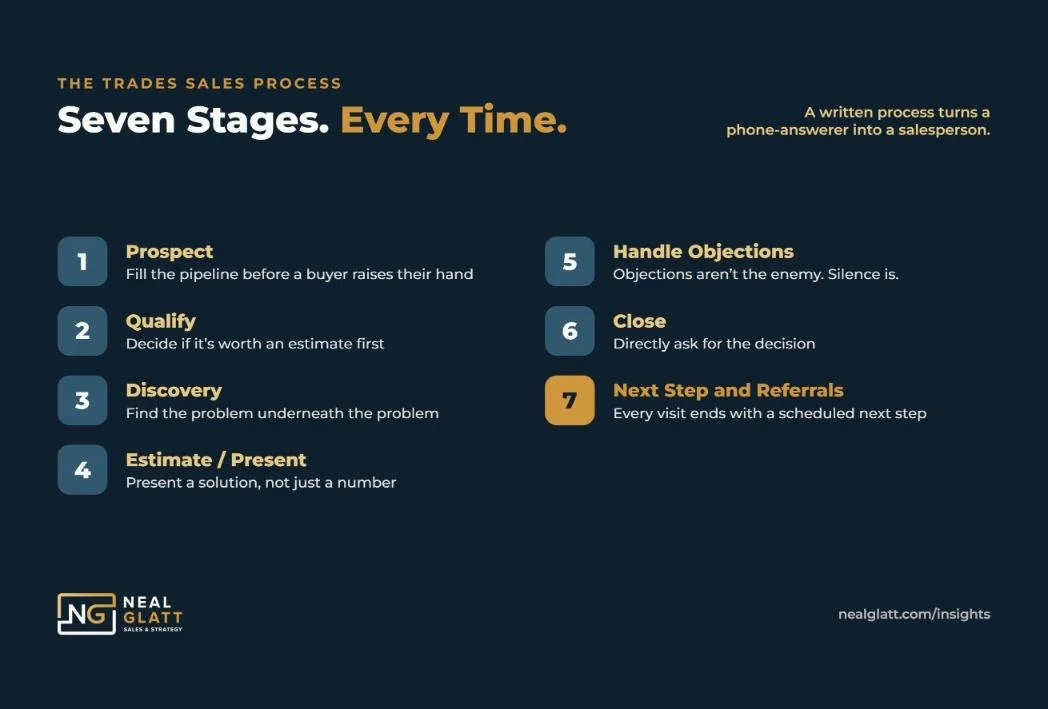
Here’s the framework I install with owners and their teams. Seven stages, in order, every time:
Prospect - generate and organize opportunities
Qualify - decide who’s worth your time before you drive out
Discovery - understand the real problem and the real stakes
Estimate / Present - deliver a solution, not just a number
Handle Objections - surface concerns and go for the no
Close - ask for the decision directly
Next Step & Referrals - advance every deal and mine your wins
Let me walk through each one with what it actually looks like on the ground.
Stage 1: Prospect
Prospecting is everything you do to fill the pipeline before a buyer raises their hand. Inbound leads count, sure, but a business that only sells to inbound is a business at the mercy of its marketing budget. The roofing companies that stay busy through a slow spring are the ones whose crews knock the neighborhood after every install, whose owner has a referral partnership with a few insurance adjusters, and whose CRM has last year’s “not right now” estimates flagged for follow-up.
The action here is simple. Define your sources and work them on a schedule. A commercial HVAC company might block two hours a week for property-manager outreach. A landscape firm might run a spring reactivation campaign to every past customer. Prospecting isn’t a mood. It’s a recurring calendar entry.
Stage 2: Qualify
This is the stage almost everyone skips, and it’s the one that saves you the most money. Qualifying means deciding whether an opportunity is worth an estimate before you spend the windshield time and the labor to produce one.
I tell owners to build three or four qualifying questions their office staff or their techs ask on the first call. What’s driving this project now? Is there a timeline or a deadline? Have you set aside a budget for it? Are you the person who makes the final decision, or is someone else involved? A plumbing company that qualifies on the phone stops sending its best estimator to price a full repipe for a tenant who can’t authorize anything and was only gathering numbers for a landlord who isn’t ready.
Qualifying before estimating is the highest-payoff change most trades businesses can make. Fewer estimates, higher close rate, better margins. You’re not trying to talk yourself out of work. You’re trying to spend your selling time where it can actually pay off.
Stage 3: Discovery
Discovery is where the real selling happens, and it’s where technicians-turned-salespeople struggle most, because your instinct is to diagnose and quote. Slow down. Before you talk about your solution, you need to understand the problem underneath the problem.
A homeowner calling an HVAC company doesn’t want a furnace. They want to stop waking up cold, stop overpaying on energy bills, and stop worrying the thing dies again in January. A facility manager calling a restoration company after a flood doesn’t want drying equipment. They want to reopen and stop losing revenue every day the space is closed. Your discovery questions are what surface the stakes. How long has this been going on? What happens if it doesn’t get fixed? What have you already tried? What matters most to you in how this gets handled?
When you understand the stakes, you can present a solution that speaks to them. Skip discovery and all you’ve got left to talk about is price.
Stage 4: Estimate / Present
Now, and only now, you present. An estimate is a number. A presentation is a solution tied to everything you just heard.
Take a paving crew presenting a sealcoat and crack-seal package for a commercial lot. Don’t lead with a per-square-foot rate. Lead with what the property manager told you mattered: no more trip-and-fall or ADA liability from those cracks, a lot that photographs clean for their tenants, work done overnight so the parking never gets blocked during business hours. Then the price lands as the cost of getting exactly that. Same work, completely different conversation. Present the outcome first, the scope second, the price last.
Stage 5: Handle Objections - And Go for the No
Objections aren’t the enemy. Silence is. When a customer says “that’s more than I expected” or “I need to think about it,” they’re still engaged. They’re telling you what’s standing between you and a yes.
The counterintuitive move I coach hardest is what I call going for the no. Instead of pushing toward a yes, you give the customer explicit permission to decline. “It’s completely fine if this isn’t the right fit. I’d rather you tell me now than feel pressured. Is there a reason this wouldn’t work for you?” That question does two things. It lowers the pressure, which paradoxically makes people more honest and more willing to buy. And it surfaces the real objection instead of the polite brush-off. An electrician who asks “is there any reason you wouldn’t move forward today?” learns whether the holdup is price, timing, or a spouse who isn’t in the room. Now they can actually address it.
Stage 6: Close
Closing is nothing more than directly asking for the decision. It should feel anticlimactic, because if you qualified well, ran real discovery, presented to the stakes, and handled objections the close is just the natural next sentence. “Do you want to move forward?” Or, “Can we get you on the schedule?”
The reason closes feel hard in the trades is that reps skip the earlier stages and then try to muscle a yes at the end. You can’t close your way out of a bad discovery. Fix the front of the process and the close takes care of itself.
Stage 7: Next Step and Referrals
Every interaction ends with a defined next step, a scheduled action, on a date, that advances the deal. “I’ll email you the estimate” isn’t a next step. It’s a dead end. “I’ll send this over this afternoon, and let’s put fifteen minutes on the calendar Thursday at 9 to walk through it and get your questions answered.” That’s a next step. It keeps the deal from stalling in the silence that kills so many trades sales.
And when you win, don’t just move on. The moment a customer is happiest, right after a roof goes on clean or a system runs quiet again, is the moment to ask for the referral and the review. Build it into the process so it happens every time, not just when someone remembers.
Use the Process as a Diagnostic
Here’s the payoff most owners don’t see coming. Once you have a defined process with stages, your pipeline becomes a diagnostic tool. When deals dry up, you can pinpoint exactly where.
If a rep drives to plenty of estimates but closes few, the problem is discovery or presentation, not effort. If deals pile up after the estimate and never move, the problem is that nobody’s laying out next steps. If your best estimator crushes it and everyone else lags, you’ve got a coaching gap, not a hiring gap. Without stages, all you have is a gut feeling and a bad month. With stages, you have a specific fix.
That’s the real reason to build the process. Not the paperwork. The visibility.
Turning This Into Practice
Reading a playbook and running one are different things. The hard part isn’t understanding these seven stages. It’s defining them for your trade, your average ticket, and your team, and then getting people who came up as technicians to actually run them under pressure.
That’s the work I do. In a Planning engagement, I come on-site for two days and build your sales process end to end: your target market and ideal customer, your revenue goals, your qualifying criteria, and the KPI infrastructure to track every stage so your pipeline becomes the diagnostic I just described. Then through Fractional Sales Management and Coaching, I install it. Weekly one-on-one coaching with your reps, facilitating your weekly sales meeting, tracking the numbers, and supporting your CRM so the process sticks instead of sliding back into order-taking.
You’ve got the craft handled. Let’s get the selling handled too. If you’re ready to stop hoping the phone rings and start running a process that grows the business, reach out. That’s exactly what I install with owners like you.
Frequently Asked Questions
What is a trades sales process? A trades sales process is a defined, repeatable sequence of stages a contractor follows to turn an opportunity into a sold job: prospect, qualify, discovery, present, handle objections, close, and next step. It replaces the reactive “phone rings, send a price, hope” habit with a consistent road every salesperson follows, which makes results predictable, measurable, and transferable to new hires.
Why should I qualify a lead before giving an estimate? Qualifying before estimating saves your most expensive resource, which is selling time. By asking a few questions upfront about the customer’s timeline, budget, decision-making authority, and motivation, you avoid driving out to price jobs for people who were never going to buy. Contractors who qualify first send fewer estimates but close a higher percentage of them, protecting both margins and their schedule.
How do I stop deals from stalling after I send an estimate? Deals stall when there’s no defined next step. “I’ll email the estimate” is a dead end because it hands all control to the customer. Instead, before you leave, schedule a specific follow-up: a set date and time to review the estimate together and answer questions. A concrete, calendared next action keeps the deal moving instead of dying in silence.
What does “go for the no” mean in sales? Going for the no means giving a prospect explicit permission to decline rather than pushing for a yes. You ask something like, “It’s fine if this isn’t the right fit, is there any reason it wouldn’t work for you?” This lowers pressure, which makes buyers more honest, and it surfaces the real objection instead of a polite brush-off, so you can actually address what’s holding them back.
How can a sales process help me diagnose problems in my business? When your sales process has defined stages, your pipeline shows you exactly where deals fail. Lots of estimates but few closes points to weak discovery or presentation. Deals stuck after the estimate point to missing next steps. One rep outperforming everyone points to a coaching gap. Without stages you only have a gut feeling. With them you get a specific, fixable diagnosis.
Glossary
Sales process - A defined, repeatable sequence of stages that moves an opportunity from first contact to a closed job and beyond: prospect, qualify, discovery, present, handle objections, close, and next step. In the trades, it replaces reactive order-taking with a consistent road every salesperson follows, making results measurable, coachable, and transferable to new hires instead of locked in one person’s habits.
Go for the no - A sales technique where you give the prospect explicit permission to decline rather than pressuring them toward a yes. By asking whether there’s any reason the deal wouldn’t work, you lower the tension, which makes buyers more forthcoming, and you surface the real objection instead of a polite stall, letting you address the actual concern.
Next step (advance) - A specific, scheduled action that moves a deal forward, agreed upon before an interaction ends. Unlike a vague “I’ll be in touch,” an advance has a date and a purpose, like a booked call to review the estimate. It keeps control of the sale and prevents deals from stalling in the silence that follows an emailed price.
Sales qualifying - The stage of evaluating whether an opportunity is worth pursuing before investing time in an estimate or proposal. Qualifying uses a few targeted questions about the prospect’s motivation, timeline, budget, and decision-making authority. For trades businesses, qualifying before estimating dramatically reduces wasted windshield time, raises close rates, and protects margin by focusing selling effort where it can actually pay off.
