
Every engagement I run starts the same way. Start with the assessment, and then don’t make any decisions. Not a hire, not a firing, not a comp change, not a new CRM, no training program. Nothing moves until you have an objective baseline on the people carrying your revenue. Before that, whatever you do is really just a guess wearing a suit.
I get pushback on this all the time. An owner calls me because sales are flat, and he’s already decided what he wants to do. Fire the guy who’s coasting. Send everybody to a two-day training. Go hire a “hunter.” And I tell him the same thing every time: I can’t make any progress coaching or in person without the assessment. I don’t even know these people’s names yet. I’m not trying to be difficult. I just won’t operate on a body nobody’s scanned.
You Wouldn’t Operate Before the MRI
Think about how medicine works when the stakes are real. You walk in with pain in your knee. A good surgeon doesn’t cut you open because you pointed at the sore spot. He orders an MRI. He wants to see the tissue and the tear, the thing you can’t feel from the outside, before anybody picks up a scalpel. Operating on a hunch is malpractice.
So I run an MRI for the sales function. Same idea, same discipline. It’s an MRI for salespeople and for whole sales organizations, and the whole reason it exists is to stop owners from restructuring a team based on symptoms. Symptoms lie. A rep who’s “not motivated” might be plenty motivated and just stuck behind a broken process. A “great closer” might be an order-taker riding a wave of inbound leads that has nothing to do with his skill. The owner’s gut feels certain about it. The gut is often wrong, and it gets expensive when it is.
I watched a landscaping company owner spend a full year “developing” a rep who was never going to sell, while the one person who could actually sell sat in a coordinator seat answering phones. Neither problem was visible from the outside. Both were obvious the minute we scanned. And we’re talking about real money here. Between the direct cost of a churned hire and the production a real seller would have put on the board, one wrong sales hire runs the average company close to $800,000. That’s what operating on a hunch costs.
What the Sales MRI Actually Measures
This isn’t a personality quiz, and it isn’t a fifteen-minute online questionnaire that hands you back a color. It evaluates roughly 21 sales competencies for every person on your team, sorted into three areas.
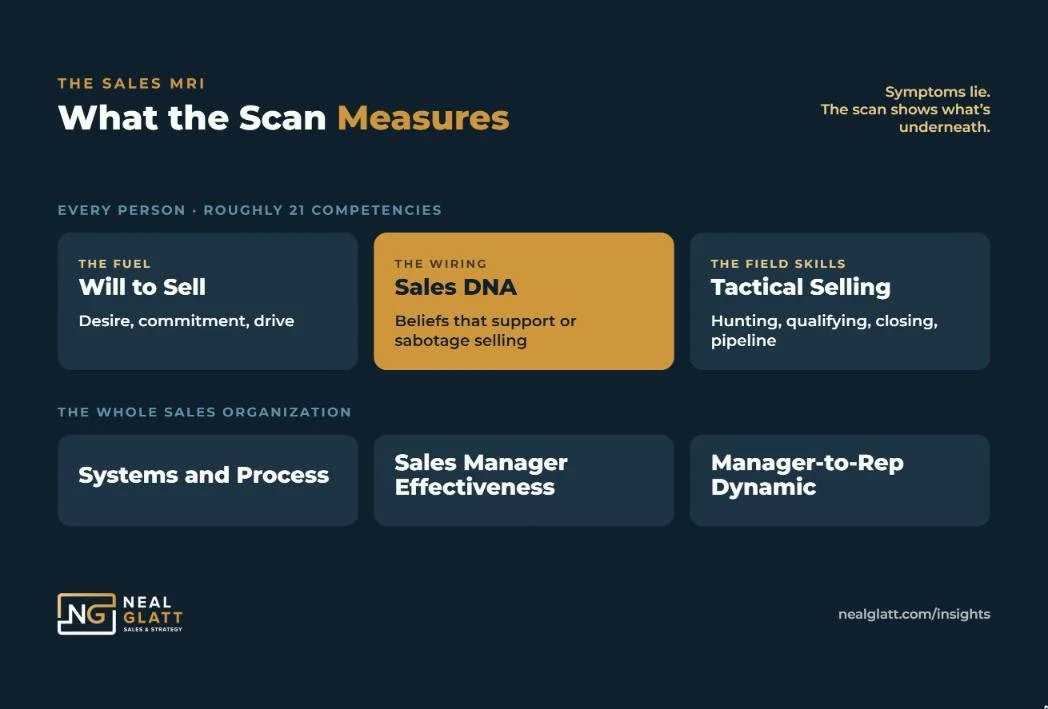
Will to Sell is the fuel. Does this person actually want to sell, with the desire and commitment and drive behind it, or do they just tolerate it because it pays the bills? Sales DNA is the wiring underneath the behavior, the beliefs and instincts that either support selling or work against it. A need to be liked that makes someone fold on price. Real discomfort talking about money. Then Tactical Selling is the skill set out on the field, the hunting and qualifying, the consultative questioning, presenting, closing, running a pipeline.
Here’s what makes it an evaluation of your sales organization instead of just a stack of individual report cards. It also looks at the systems and process you’ve got in place, the effectiveness of your sales manager, and the dynamic between that manager and each rep. A great rep under a manager who never coaches is a wasted asset. A mediocre process makes your best people look average. You’ve got to see all of it at once. At the team level, that organizational view has a name, the SEIA, the Sales Effectiveness and Improvement Analysis, and it’s what turns a pile of individual reports into one prioritized plan for the whole function.
It answers about 25 standard questions every sales leader is carrying around. Who can close, who’s coachable, why the pipeline never converts. And then it does the thing owners never see coming. It quantifies how much additional revenue is realistically sitting inside your existing team, and over what period of time. That’s the ROI of investing in your salesforce as an actual number, not a vibe.
You’re Not Buying a Test. You’re Buying a Plan.
What lands on your desk isn’t a score. It’s a strategic plan for the sales function. Who belongs in which seat. Who to develop, and how to develop them. Who to reconsider. Each person’s specific development opportunities. The fixes your systems and process need. And what any training you buy should actually deliver, so you’re not paying a motivational speaker when your real problem is qualifying discipline.
I tell every owner the same thing up front. We’ll confirm what you already know is going well, and that part won’t surprise you. Then we’ll find the hidden risks you don’t know about, and we lay out the whole plan around them. The confirmation feels good. The hidden risks are where the money is.
The Diagnoses I See Over and Over
Different trades, same patterns. After you’ve run enough of these, you start recognizing the X-rays on sight.
The most common one by far: reps acting as order-takers instead of proactive salespeople. It’s everywhere in businesses lucky enough to have strong inbound demand. The HVAC company whose phone rings because they’ve been in town for thirty years. The restoration firm fed by insurance referrals. Those reps aren’t selling, they’re processing. They quote what gets asked for and move on. That works fine right up until demand softens, or you want to grow faster than the phone rings, and then you find out you’ve got a team that’s never actually had to create a sale.
Right behind it is the over-inflated pipeline. A plumbing company shows me a forecast that looks fantastic, packed with deals nobody ever qualified. No budget confirmed, no decision-maker identified, no real timeline. And the rep believes every last one of them. He’s not lying to me. He can’t tell a real opportunity from a polite maybe, and that’s a Sales DNA and Tactics gap the assessment names precisely.
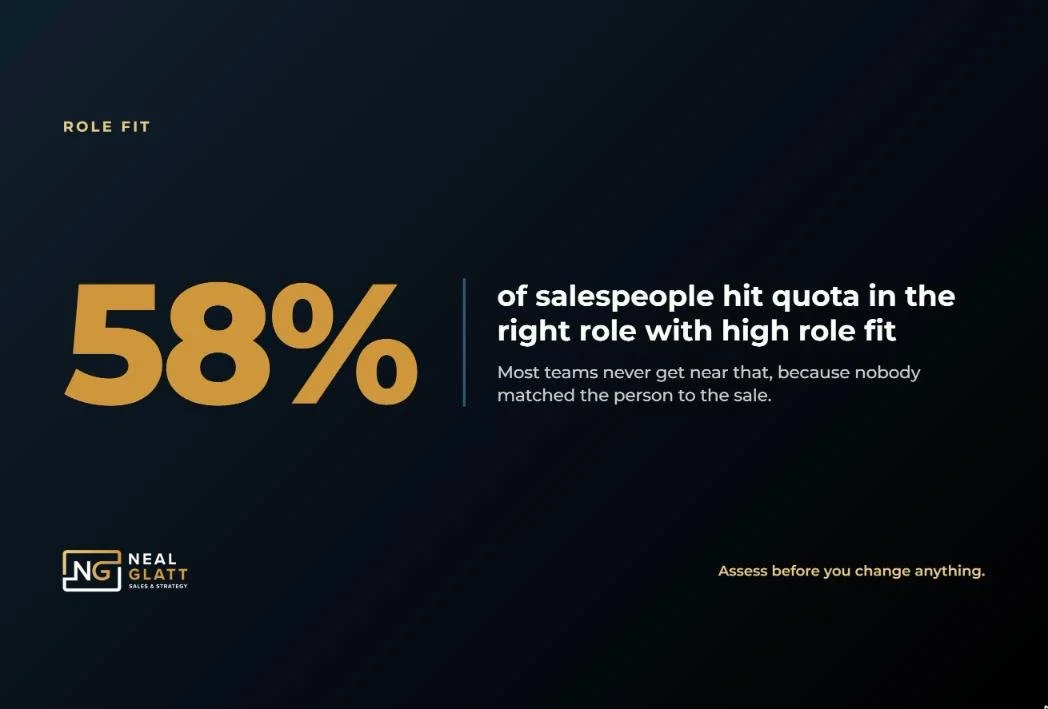
Then you’ve got the person in the wrong seat. Sometimes your best “salesperson” is a phenomenal account manager who should never be sent to hunt cold, and your quiet coordinator has more raw selling instinct than anyone on the roster. And a lot of the time the real gap isn’t a rep at all. It’s a capable, well-liked sales manager whose actual weakness is coaching consistency. He can do the job himself but can’t reliably build it in other people, so the whole team plateaus right at his personal ceiling. This shows up more than owners want to admit. The research says the majority of salespeople are in the wrong role, and role fit alone is a huge lever. 58% of salespeople hit quota when they’re in the right role with high role fit, a level most teams never get near because nobody ever matched the person to the sale.
The single most valuable thing this assessment does is separate genuine sales potential from a lack of effective habits. That one distinction is everything. It’s the line between a coaching project and a hiring mistake. One is worth your investment for the next three years. The other is worth a respectful conversation and an open req. From the outside they look identical, and the owner usually can’t tell them apart. That’s the whole reason he’s been stuck.
Fix or Replace, Without the Agony
Every owner I work with is carrying at least one develop-versus-replace decision, and it’s eating them alive. It gets tangled up in loyalty. This person was here in the early days, their family counts on the job. And it gets tangled up in performance, which is pulling the other way. So they do nothing, for months, sometimes years, and the indecision ends up costing more than either choice would have.
The assessment turns that from a gut call into a data decision. It won’t tell you what to value. You still decide how much loyalty is worth. But it tells you the truth about capability, so at least you’re deciding with facts on the table instead of guilt and hope. And owners love this next part: the same science that evaluates your current team later screens your new hires. Once you’ve watched it work on people you already know, you won’t make another offer without it. That’s the end of the expensive gut-feel hire.
The Take Most Owners Argue With First
Anyone whose job is keeping and upselling a client is in sales. So assess them as salespeople too.
Your account managers. Your client-relations people. The “customer success” person at your pest control company who handles renewals. The service manager at your commercial landscaping firm who owns the book of recurring accounts. Owners push back on this because those folks don’t carry a quota and don’t think of themselves as sellers. But in a facilities-services or skilled-trades business, retention and recurring revenue are the business. The account rep protecting and expanding a pavement-maintenance contract or a managed-services agreement is doing the highest-use selling you’ve got. If they’re passive order-takers, you’re leaking money on the accounts you already fought to win. They belong in the scan.
How It Actually Works
It’s built to be painless. Each person takes an online assessment, about 45 to 60 minutes, inside a one-week window. We take roughly a week after that to process the results properly. Then we spend around four hours together in debrief, starting with a 90-minute session where I walk you through the whole picture and the plan.
I frame it for the team the same way every time, because it matters. This is productive and optimistic, not a test for your job. It’s built to find where each person can grow and where the company is holding them back. And about twelve months later we run a free reassessment, to measure how well the training and coaching actually worked and to rebuild next year’s plan on fresh data. You get a baseline, an intervention, and proof.
Why This Is the On-Ramp
I lead with assessing because it de-risks everything downstream. Every hiring decision, every coaching plan, every training dollar, every restructuring gets smarter and cheaper once you’re working from a scan instead of a hunch. You stop developing the undevelopable. You stop firing your best hidden talent. And you stop buying training that treats the wrong disease.
My Assessing engagement starts at $5,000 and includes the full assessment of your team, the complete debrief, and the written strategic plan for your sales function. It’s the single best first move an owner can make, because it’s the one decision that makes all the other decisions right. Start with the assessment. Then we’ll decide together, with the scan in front of us.
Frequently Asked Questions
What is a Sales MRI or sales force evaluation? A sales force evaluation, which I call a Sales MRI, is an objective assessment of your entire sales function before you change anything. It measures each person across roughly 21 competencies, plus your systems, your sales manager, and the manager-to-rep dynamic. Like a medical MRI, it shows you what you can’t see from the outside, so you stop making hiring and coaching decisions on a hunch.
Why assess before hiring, firing, or training? Because symptoms lie. A rep who looks unmotivated might be trapped behind a broken process, and a “great closer” might just be an order-taker riding inbound leads. Without a baseline, every decision is a guess. The assessment separates genuine sales potential from a lack of effective habits, so you know whether someone is a coaching project or a hiring mistake before you spend a dollar on either.
What does the assessment actually tell me? It delivers a strategic plan, not a test score. You learn who belongs in which seat, who to develop and how, who to reconsider, each person’s specific development opportunities, the fixes your systems need, and what training should deliver. It also quantifies how much additional revenue is realistically sitting inside your current team, and over what period. That’s the ROI of investing in your salesforce.
Should account managers be assessed too? Absolutely. Anyone whose job is to keep and upsell a client is in sales, quota or no quota. In skilled-trades and facilities-services businesses, retention and recurring revenue are the business, so account managers and client-relations roles are doing your highest-use selling. If they behave as passive order-takers, you leak money on hard-won accounts. Assess them as salespeople.
How long does the Sales MRI take? Each person completes an online assessment in about 45 to 60 minutes inside a one-week window. Processing takes roughly a week, then about four hours of debrief that begins with a 90-minute session walking through the full plan. Around twelve months later, a free reassessment measures training effectiveness and rebuilds next year’s plan on fresh data.
Glossary
Sales force evaluation (Sales MRI) - An objective, data-driven assessment of an entire sales organization run before any personnel or process changes. It scans each rep’s competencies plus the systems, the sales manager, and the manager-to-rep dynamic. Named after a medical MRI because it reveals hidden risks and true capability that can’t be diagnosed from outward symptoms, letting owners decide with facts instead of gut instinct.
21 sales core competencies - The roughly 21 measured attributes that determine whether a person can sell, grouped into Will to Sell (desire and drive), Sales DNA (the underlying beliefs and instincts that support or sabotage selling), and Tactical Selling (field skills like qualifying, questioning, and closing). Assessing all three explains not just whether someone performs, but why, and how much they can improve.
Order-taker - A salesperson who passively processes incoming demand instead of proactively creating sales. Common in trades with strong inbound leads or referrals, order-takers quote what’s requested and move on, never qualifying, hunting, or expanding accounts. They look competent while demand is high but expose the business the moment growth has to outpace the phone ringing. The assessment identifies them clearly.
Fix-or-replace decision - The develop-versus-replace choice owners agonize over, tangled with loyalty and performance, that often stalls for months. The Sales MRI turns it from a gut call into a data decision by revealing whether a struggling rep has genuine, coachable potential or a fundamental gap. The owner still weighs loyalty, but now decides with the truth about capability on the table.
