
I once watched a landscaping owner turn down the guy who would’ve been his best salesperson in a decade. Why? A personality test said he wasn’t a “high-D.” Around the same time I watched an HVAC company hire the assertive, backslapping extrovert that same kind of test loved. Six months later they were scratching their heads wondering why he couldn’t close a replacement system to save his life. Both owners thought they were being disciplined and data-driven. And both were leaning on a tool that has never once measured whether a person can sell.
If you’ve ever run a candidate through DISC, Myers-Briggs, Kolbe, or Predictive Index before a sales hire, this one’s going to save you money and turnover. I’ve had to break this news to a lot of good operators, so I’ll just say it plainly. Those tools measure personality and communication style. They don’t measure sales ability. It looks like a really sexy version of a lot of stuff, but it isn’t predictive of sales success.
The Belief That’s Costing You Good Hires
Somewhere along the way our industry decided that selling belongs to a personality type. You need to be a high-D. Hire the outgoing one. Salespeople are born, not made. Owners soak that up, reach for a personality assessment to confirm it, and the assessment happily plays along, because describing personality is what it’s built to do.
Style tools tell you how a person tends to communicate. That’s useful for team dynamics, for coaching, for figuring out why your ops manager and your dispatcher rub each other the wrong way. So I’m not going to tell you DISC is worthless. I’m telling you it was never designed to answer the question you’re actually asking at the hiring table. Will this person go out and sell my roofing jobs, my pest control contracts, my paving accounts?
Think about the life-of-the-party CFO for a second. Loud, funny, the one telling stories at the holiday party. A personality-style test would probably flag him as a terrible fit for a detail-obsessed finance job. Plenty of guys like that are excellent at it anyway. The tool mispredicts because it’s reading surface behavior instead of real capability. The same thing happens with your salespeople, just pointed the other way. It green-lights the wrong people and red-lights the right ones.
The Measurement Flaw Nobody Talks About
Here’s the core problem, and once you see it you can’t unsee it.
Most assessments get validated the same lazy way. They look at your top performers, find what those people have in common, and declare those shared traits the “profile” of success. Sounds rigorous. It isn’t. They never bother to check whether the bottom performers have those exact same traits.
Sit with what that means. Your top three salespeople might all be extroverts, so the tool decides extroversion predicts selling. But if your three worst salespeople are also extroverts, then extroversion predicts nothing. It’s just something everyone in your building happens to share. That’s a finding everyone has in common, and it isn’t predictive of anything. It’s noise wearing a lab coat.
A predictive assessment has to do the harder thing. It has to find the tendencies of top performers that are missing from the bottom performers. The trait only counts if the people who fail don’t have it. In all my years doing this, the sales-specific assessment I use - Objective Management Group’s - is the only one I’m aware of that finds the tendencies of top performers that are absent from the bottom performers. It validates against failure, not just success.
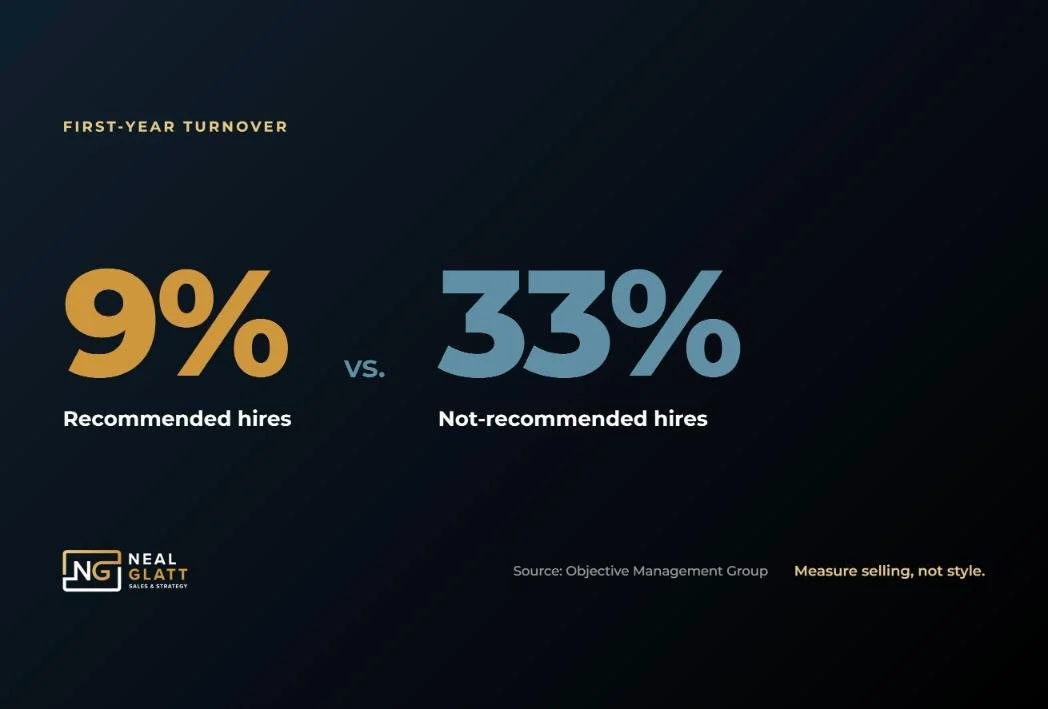
And the proof is in the retention data, not some marketing claim. Across the 80,000-plus salespeople OMG assesses every year, all 21 competencies show a statistically significant correlation to top-performing sellers. Now here’s the number that should stop you cold. OMG-recommended candidates leave in their first year at a rate of 9%. Candidates the tool flagged as not-recommended leave at 33%. Same jobs, same companies. The only difference is whether the hire had the sales-specific traits a personality test can’t see. When you’re spending real money to hire and ramp a salesperson in a skilled trade, that gap is the difference between a producer and an eighteen-month mistake.
What Actually Predicts Selling
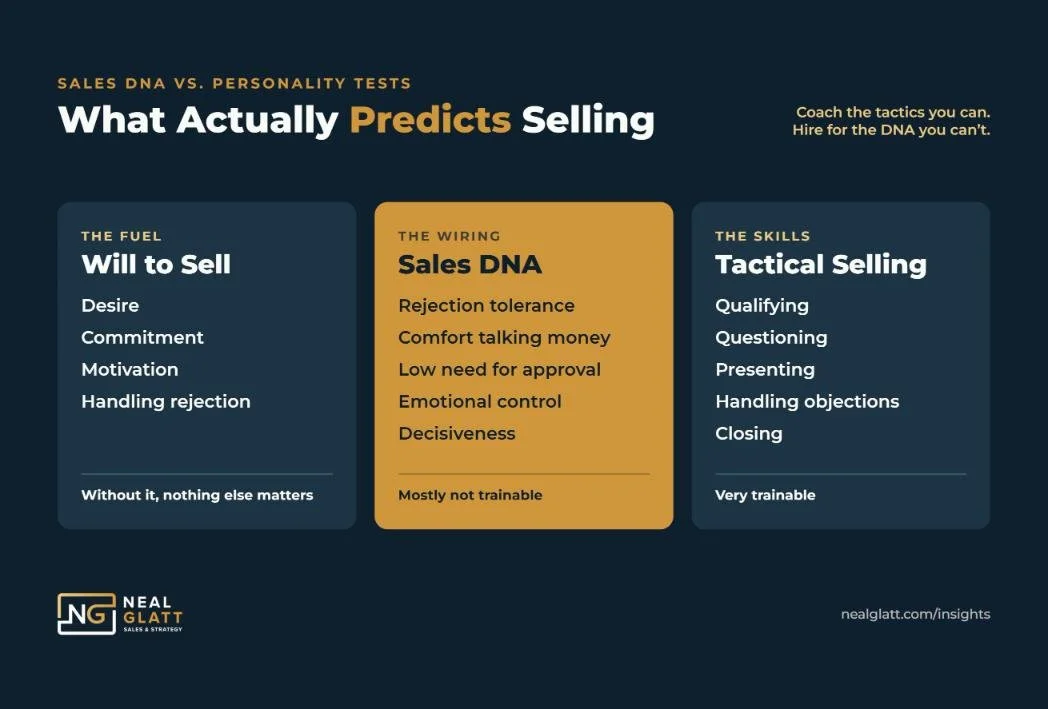
So if personality doesn’t predict it, what does? The sales-specific assessment measures three things, and they’re worth understanding on their own because each one behaves differently once somebody’s on your payroll.
Will to Sell
The first bucket is desire, commitment, motivation, and how a person handles rejection. Does this person actually want to sell? Not want a sales paycheck. Want to do the work of selling, including the uncomfortable parts. A plumber’s estimator with elite technical knowledge and no will to sell turns into an order-taker who quotes and hopes. Will to Sell is the engine. Without it, nothing else matters.
Sales DNA
The second bucket is the one most people have never heard of, and it changes everything. Sales DNA is the set of beliefs and attitudes sitting underneath behavior. The way I explain it: a behavior is a learned result of beliefs and attitudes. We ask about the beliefs and attitudes, and we call that Sales DNA.
It measures things like rejection tolerance, comfort talking about money, a low need for approval, emotional regulation in a sales conversation, decisiveness. These aren’t skills. They’re the operating system underneath the skills. A tech who’s deeply uncomfortable talking about money will find a way to rush past the price, discount before anyone asks, or “circle back later” on a $14,000 job, no matter how many times you tell him not to. A rep who badly needs to be liked won’t hold the line when a restoration customer pushes back. What you see on a ride-along is just the beliefs leaking out.
Tactical Selling
The third bucket is the learnable stuff. Qualifying, questioning, presenting, handling objections, closing. This is the trainable part, and it’s what I coach every day. I can move it fast in someone who has the first two buckets.
Why This Changes How You Hire
Tactics are trainable. Sales DNA mostly isn’t. I can teach your paving account rep a better discovery process in a month. What I can’t do is out-coach 20 years of how somebody was raised. If a person grew up believing that talking about money is rude, I’m not undoing that in a quarterly training. If somebody’s whole identity runs on being liked, no role-play is going to coach that out of him. And if rejection genuinely flattens a person, maybe sales isn’t the right seat for him. That’s not an insult. It’s a fit conversation, and it’s a whole lot kinder to have before the hire than eight painful months after.
Let me give you a real one, anonymized. I assessed a rep who was talented. Sharp, likable, technically strong, the guy every owner wants to bet on. And he was great, right up until somebody told him no twice. If that second “no” hit at 11 a.m. on a Tuesday, he was done prospecting for the week. Just done. A personality test looked at him and saw “assertive, confident, high-D,” and it scored him beautifully. What it never saw, what it couldn’t see, is that he wasn’t rejection-proof. His Sales DNA had a crack in it that no style assessment is built to catch. That crack was the whole story of his production, and the personality test missed it.
The Hidden Gems You’re Throwing Away
There’s an upside here that most owners never get to enjoy, because Sales DNA doesn’t show up on a resume.
You can’t see rejection tolerance in a work history. A low need for approval isn’t hiding in a list of previous employers. So when the right assessment surfaces those traits, it keeps finding high-potential people you’d have tossed in the discard pile. The 24-year-old with no sales title yet. The career-changer coming off the field. The parts counter guy who’s never sold a thing but happens to have the exact operating system that makes selling stick. In trades where good salespeople are almost impossible to find, being able to spot raw sales talent before it has a track record is a real advantage. I’ve helped owners build whole teams out of people their competitors would never have bothered to interview.
Turning the Science Into a Decision
Data doesn’t hire anybody. You do. My job is to turn the science into decisions you can actually act on.
That’s what my two engagements are for. In an Assessing engagement ($5,000+), I use the sales-specific assessment on your existing team, so you finally know who can be coached up, who’s miscast, and where your real gaps are before you spend another dollar. In a Hiring engagement ($11,000+), I use it to screen your candidates end to end, so you stop betting five and six figures of ramp cost on a gut feel and a personality report that was never predictive to begin with.
Either way, I’m not handing you a stack of graphs and wishing you luck. I sit down with you and turn the science into decisions. Stop hiring the person the personality test likes. Start hiring the person who can actually sell.
Frequently Asked Questions
Do personality tests like DISC predict sales success? Not at all. Tools like DISC, Myers-Briggs, Kolbe, and Predictive Index measure personality and communication style, not sales ability. They describe how someone tends to communicate, which helps with team dynamics, but they were never designed to predict whether a person can actually sell. A sales-specific assessment gets validated against real outcomes instead. OMG, for example, sees its recommended candidates leave at 9% in year one versus 33% for the ones it flags as not-recommended, because it measures the traits that actually drive selling.
What is Sales DNA? Sales DNA is the set of beliefs and attitudes sitting underneath sales behavior, the operating system that drives what a salesperson does. It covers rejection tolerance, comfort talking about money, a low need for approval, emotional regulation, and decisiveness. The idea is straightforward: a behavior is a learned result of beliefs and attitudes, so instead of just watching behavior, a sales-specific assessment measures the beliefs and attitudes producing it.
Can you train someone to be better at sales? Partly. Tactical selling skills like qualifying, questioning, presenting, handling objections, and closing are learnable and can be coached quickly. Sales DNA mostly can’t be trained, because it reflects deep-seated beliefs formed over a lifetime. You can’t out-coach 20 years of how someone was raised. If a person believes talking about money is rude, or needs to be liked, or can’t absorb rejection, training rarely fixes it.
What makes a sales assessment actually predictive? Predictive validity comes from checking that the traits of top performers are absent from bottom performers, not just shared among the best. Most tools only find what top performers have in common and never verify whether weak performers share those same traits. If both groups have a trait, it predicts nothing. A sales-specific assessment validates against real outcomes: OMG shows all 21 of its competencies correlate significantly with top performers, and its recommended candidates leave at 9% in year one versus 33% for not-recommended.
Why do good sales candidates get overlooked? Because Sales DNA doesn’t show up on a resume. You can’t see rejection tolerance, comfort with money, or a low need for approval in a work history, so owners screen those people out. A sales-specific assessment surfaces high-potential candidates who lack a sales track record - young hires, career-changers, field techs - revealing raw selling ability that competitors relying on resumes and personality tests never even interview.
Glossary
Sales DNA - The beliefs and attitudes underneath sales behavior, the operating system that drives what a salesperson does under pressure. It includes rejection tolerance, comfort talking about money, a low need for approval, emotional regulation, and decisiveness. Because a behavior is a learned result of beliefs and attitudes, Sales DNA measures those root drivers rather than the surface behavior, and it’s largely not trainable.
Will to Sell - The desire, commitment, and motivation to actually do the work of selling, plus how a person handles rejection. It’s the engine of sales performance. Without it, skills and knowledge go unused. A technically gifted estimator with no Will to Sell drifts into order-taking. It’s distinct from wanting a sales paycheck. It’s wanting to do the uncomfortable work selling requires.
Predictive validity - The degree to which an assessment actually forecasts real-world sales performance. True predictive validity requires that a trait found in top performers is absent from bottom performers. If both groups share it, it predicts nothing. OMG validates this continuously: all 21 of its competencies correlate significantly with top performers, and its recommended candidates leave in year one at 9% versus 33% for not-recommended, outcome-based proof a personality test can’t offer.
Sales-specific assessment - An evaluation built and validated specifically to predict selling ability, rather than describe personality or communication style. It measures Will to Sell, Sales DNA, and Tactical Selling, and validates against real outcomes rather than personality type. Objective Management Group’s - backed by 30-plus years of data and 80,000 assessments a year across 35,000-plus companies - sees 9% first-year attrition among recommended candidates versus 33% among not-recommended.
